版权声明:转载请注明出处。 https://blog.csdn.net/u014427196/article/details/42287993
A. New Year Transportation
time limit per test
2 seconds
memory limit per test
256 megabytes
input
standard input
output
standard output
New Year is coming in Line World! In this world, there are n cells numbered by integers from 1 to n , as a 1 × n board. People live in cells. However, it was hard to move between distinct cells, because of the difficulty of escaping the cell. People wanted to meet people who live in other cells.
So, user tncks0121 has made a transportation system to move between these cells, to celebrate the New Year. First, he thought of n - 1 positive integers a 1 , a 2 , ..., a n - 1 . For every integer i where 1 ≤ i ≤ n - 1 the condition 1 ≤ a i ≤ n - i holds. Next, he made n - 1 portals, numbered by integers from 1 to n - 1 . The i -th ( 1 ≤ i ≤ n - 1 ) portal connects cell i and cell ( i + a i ) , and one can travel from cell i to cell ( i + a i ) using the i -th portal. Unfortunately, one cannot use the portal backwards, which means one cannot move from cell ( i + a i ) to cell i using the i -th portal. It is easy to see that because of condition 1 ≤ a i ≤ n - i one can't leave the Line World using portals.
Currently, I am standing at cell 1 , and I want to go to cell t . However, I don't know whether it is possible to go there. Please determine whether I can go to cell t by only using the construted transportation system.
Input
The first line contains two space-separated integers n ( 3 ≤ n ≤ 3 × 10 4 ) and t ( 2 ≤ t ≤ n ) — the number of cells, and the index of the cell which I want to go to.
The second line contains n - 1 space-separated integers a 1 , a 2 , ..., a n - 1 ( 1 ≤ a i ≤ n - i ). It is guaranteed, that using the given transportation system, one cannot leave the Line World.
Output
If I can go to cell t using the transportation system, print " YES ". Otherwise, print " NO ".
Sample test(s)
input
8 4
1 2 1 2 1 2 1
output
YES
input
8 5
1 2 1 2 1 1 1
output
NO
Note
In the first sample, the visited cells are: 1, 2, 4 ; so we can successfully visit the cell 4 .
In the second sample, the possible cells to visit are: 1, 2, 4, 6, 7, 8 ; so we can't visit the cell 5 , which we want to visit.
A 水题
#include<stdio.h>
#include<iostream>
#include<math.h>
#include<stdlib.h>
#include<ctype.h>
#include<algorithm>
#include<vector>
#include<string.h>
#include<queue>
#include<stack>
#include<set>
#include<map>
#include<sstream>
#include<time.h>
#include<utility>
#include<malloc.h>

using namespace std;

int n, t;

int p[30010];

int main()
{
    while (cin >> n >> t)
    {
        for (int i = 1; i <= n-1; i++)
            cin >> p[i];

        int pos = 1;

        for (int i = 1; i <= n-1;i++)
        {
            if (pos >= t)
                break;
            pos += p[pos];
        }
        if (pos == t)
            cout << "YES" << endl;
        else
            cout << "NO" << endl;
    }
    return 0;
}
B. New Year Permutation
time limit per test
2 seconds
memory limit per test
256 megabytes
input
standard input
output
standard output
User ainta has a permutation p 1 , p 2 , ..., p n . As the New Year is coming, he wants to make his permutation as pretty as possible.
Permutation a 1 , a 2 , ..., a n is prettier than permutation b 1 , b 2 , ..., b n , if and only if there exists an integer k ( 1 ≤ k ≤ n ) where a 1 = b 1 , a 2 = b 2 , ..., a k - 1 = b k - 1 and a k < b k all holds.
As known, permutation p is so sensitive that it could be only modified by swapping two distinct elements. But swapping two elements is harder than you think. Given an n × n binary matrix A , user ainta can swap the values of p i and p j ( 1 ≤ i , j ≤ n , i ≠ j ) if and only if A i , j = 1 .
Given the permutation p and the matrix A , user ainta wants to know the prettiest permutation that he can obtain.
Input
The first line contains an integer n ( 1 ≤ n ≤ 300 ) — the size of the permutation p .
The second line contains n space-separated integers p 1 , p 2 , ..., p n — the permutation p that user ainta has. Each integer between 1 and n occurs exactly once in the given permutation.
Next n lines describe the matrix A . The i -th line contains n characters ' 0 ' or ' 1 ' and describes the i -th row of A . The j -th character of the i -th line A i , j is the element on the intersection of the i -th row and the j -th column of A. It is guaranteed that, for all integers i , j where 1 ≤ i < j ≤ n , A i , j = A j , i holds. Also, for all integers i where 1 ≤ i ≤ n , A i , i = 0 holds.
Output
In the first and only line, print n space-separated integers, describing the prettiest permutation that can be obtained.
Sample test(s)
input
7
5 2 4 3 6 7 1
0001001
0000000
0000010
1000001
0000000
0010000
1001000
output
1 2 4 3 6 7 5
input
5
4 2 1 5 3
00100
00011
10010
01101
01010
output
1 2 3 4 5
Note
In the first sample, the swap needed to obtain the prettiest permutation is: ( p 1 , p 7 ) .
In the second sample, the swaps needed to obtain the prettiest permutation is ( p 1 , p 3 ), ( p 4 , p 5 ), ( p 3 , p 4 ) .
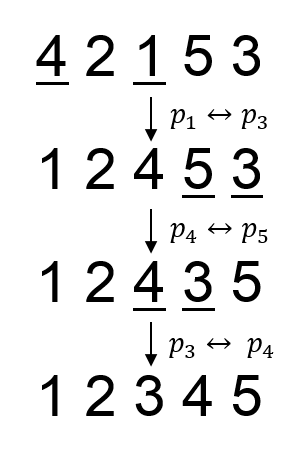
A permutation p is a sequence of integers p 1 , p 2 , ..., p n , consisting of n distinct positive integers, each of them doesn't exceed n . The i -th element of the permutation p is denoted as p i . The size of the permutation p is denoted as n .
B 弗洛伊德算法 ,并查集也可以做 ,有时间敲一下。
#include <iostream>
#include <stdio.h>
#include <math.h>
#include <algorithm>
#include <string.h>

using namespace std;

int p[305];
int b[305][305];

int n;

int main()
{
    while (cin >> n)
    {
        for (int i = 1; i <= n; i++)
            cin >> p[i];
        getchar();
        for (int i = 1; i <= n; i++)
        {
            for (int j = 1; j <= n; j++)
            {
                char c = getchar();
                b[i][j] = (c == '1');
            }
            getchar();
        }

        for (int k = 1; k <= n;k++)
            for (int  i= 1; i <= n; i++)
                for (int j = 1; j <= n; j++)
                {
                    if (b[i][k] & b[k][j])
                    {
                        b[i][j] = b[j][i] = 1;
                    }
                }

        for (int i = 1; i <= n; i++)
            for (int j = i + 1; j <= n; j++)
            {
                if (b[i][j] )
                {
                    if (p[i] > p[j])
                    {
                        swap(p[i],p[j]);
                    }
                }
            }
        for (int i = 1; i <= n; i++)
            cout << p[i] << " ";
    }
    return 0;
}
C. New Year Book Reading
New Year is coming, and Jaehyun decided to read many books during 2015, unlike this year. He has n books numbered by integers from 1 to n . The weight of the i -th ( 1 ≤ i ≤ n ) book is w i .
As Jaehyun's house is not large enough to have a bookshelf, he keeps the n books by stacking them vertically. When he wants to read a certain book x , he follows the steps described below.
- He lifts all the books above book x .
- He pushes book x out of the stack.
- He puts down the lifted books without changing their order.
- After reading book x , he puts book x on the top of the stack.
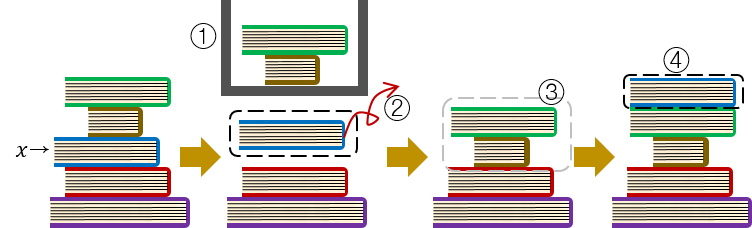
He decided to read books for m days. In the j -th ( 1 ≤ j ≤ m ) day, he will read the book that is numbered with integer b j ( 1 ≤ b j ≤ n ). To read the book, he has to use the process described in the paragraph above. It is possible that he decides to re-read the same book several times.
After making this plan, he realized that the total weight of books he should lift during m days would be too heavy. So, he decided to change the order of the stacked books before the New Year comes, and minimize the total weight. You may assume that books can be stacked in any possible order. Note that book that he is going to read on certain step isn't considered as lifted on that step. Can you help him?
Input
The first line contains two space-separated integers n ( 2 ≤ n ≤ 500 ) and m ( 1 ≤ m ≤ 1000 ) — the number of books, and the number of days for which Jaehyun would read books.
The second line contains n space-separated integers w 1 , w 2 , ..., w n ( 1 ≤ w i ≤ 100 ) — the weight of each book.
The third line contains m space separated integers b 1 , b 2 , ..., b m ( 1 ≤ b j ≤ n ) — the order of books that he would read. Note that he can read the same book more than once.
Output
Print the minimum total weight of books he should lift , which can be achieved by rearranging the order of stacked books.
Sample test(s)
Input
3 5
1 2 3
1 3 2 3 1
Output
12
Note
Here's a picture depicting the example. Each vertical column presents the stacked books.
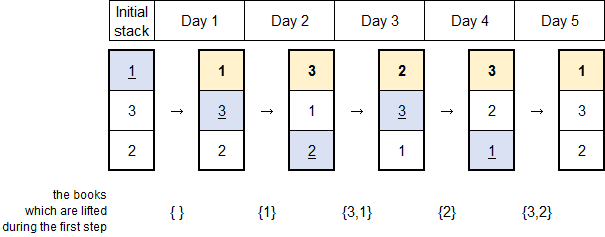
贪心后模拟。
#include<stdio.h>
#include<iostream>
#include<math.h>
#include<stdlib.h>
#include<ctype.h>
#include<algorithm>
#include<vector>
#include<string.h>
#include<queue>
#include<stack>
#include<set>
#include<map>
#include<sstream>
#include<time.h>
#include<utility>
#include<malloc.h>

using namespace std;

int n, m;
int p[510];
int q[1010], qq[1010];
int vis[1010];

int main()
{
    while (cin >> n >> m)
    {
        for (int i = 1; i <= n; i++)
        {
            cin >> p[i];
        }

        memset(vis,0,sizeof(vis));

        int pos = 1;
        for (int i = 1; i <= m; i++)
        {
            int jjq;
            cin >> jjq;
            q[i] = jjq;
            if (!vis[jjq])
            {
                qq[pos++] = jjq;
                vis[jjq] = 1;
            }
        }

        long long ans = 0;
        for (int i = 1; i <= m; i++)
        {
            int tt = q[i];
            for (int j = 1; j <= n; j++)
            {
                if (qq[j] != tt)
                {
                    ans += p[qq[j]];
                }
                else
                {
                    for (int k = j; k > 1 ; k--)
                    {
                        qq[k] = qq[k-1];
                    }
                    qq[1] = tt;
                    break;
                }
            }
        }

        cout << ans << endl;
    }
    return 0;
}
留言